Working from home sounds comfortable… until your neck, back, and shoulders start protesting. The reality is simple: your body is designed for movement, not hours of static sitting. Even a “perfect posture” can become a problem if you stay in it too long.
Why does working from home cause pain?
When you sit for long periods while working from home, your muscles gradually become stiff and overworked, while your joints receive less movement and nutrition, making them less efficient. Over time, your postural muscles begin to fatigue, which leads to slouching and poor positioning, and this shifts load onto more sensitive structures such as the neck, lower back, and shoulders.
As a result, people commonly experience symptoms like neck pain, headaches, lower back pain, and shoulder tightness. The key issue is not just posture itself, but the lack of regular movement throughout the day, which plays a much bigger role in the development of pain.
What is the “ideal” desk set up?
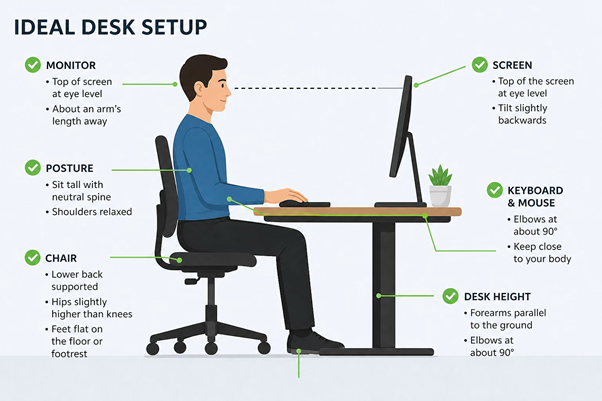
Your chair setup plays a key role in keeping your body comfortable and supported throughout the day. Ideally, your hips should be slightly higher than your knees, with your feet flat on the floor or supported by a footrest. Your lower back should be well supported using built-in lumbar support or even a small pillow. Your screen should be positioned so that the top is at eye level and about an arm’s length away, helping you avoid looking down for long periods—if you’re using a laptop, a stand can make a big difference.
Your keyboard and mouse should be placed close to your body so your elbows stay around 90 degrees and your shoulders remain relaxed rather than shrugged. Desk height should allow your forearms to stay parallel to the ground, while your wrists remain in a neutral position without bending up or down. This setup helps reduce unnecessary strain on your muscles and joints during prolonged work hours.
The rule most people ignore (and it matters more than posture)
No posture is perfect if you don’t move, which is why regular movement throughout the day is essential. A simple and effective rule is to stand, stretch, or walk for 1 to 2 minutes every 30 to 45 minutes to keep your body active and reduce stiffness. Think of your body like a sponge, when you move, it absorbs nutrients and stays healthy, but when you stay still for too long, it becomes stiff and less effective, increasing the likelihood of pain and discomfort.
What does the evidence say?
High-quality research shows that exercise and regular movement help reduce pain and improve function in people with neck and back pain, while ergonomic changes alone tend to have limited long-term effects unless they are combined with movement. Taking regular breaks and staying active throughout the day play a key role in preventing pain. In simple terms, a perfect chair won’t fix pain, but movement will.
Common mistakes
Working from the couch or bed often leads to poor support and awkward positioning, placing unnecessary strain on your body. Keeping your laptop too low can result in constant neck flexion, increasing stress on the neck and upper back. Sitting for hours without breaks contributes to stiffness and discomfort, and trying to “sit straight” all day can lead to muscle fatigue rather than improving posture.
Key takeaway:
Posture is important, but movement is essential. Instead of chasing the idea of a perfect posture, focus on having a good setup, incorporating regular movement throughout your day, and gradually conditioning your body so it can tolerate different positions and loads more effectively over time.
Final thought:
Instead of asking what the perfect posture is, start asking how often you are moving throughout the day. The focus should shift from trying to maintain a single ideal position to regularly changing positions and staying active, because the best posture is simply the next one.
References:
Cochrane Database of Systematic Reviews (Cochrane Rev) – Ergonomics alone limited without additional interventions
British Journal of Sports Medicine (BJSM) – Exercise reduces risk and improves low back pain
The Lancet (Lancet) – Movement and education preferred over passive treatment
Cochrane Database of Systematic Reviews (Cochrane Rev) – Combined ergonomic and physical approaches more effective
Journal of Orthopaedic & Sports Physical Therapy (JOSPT) – Strong recommendation for exercise and staying active
Cochrane Database of Systematic Reviews (Cochrane Rev) – Prolonged sitting linked to musculoskeletal discomfort